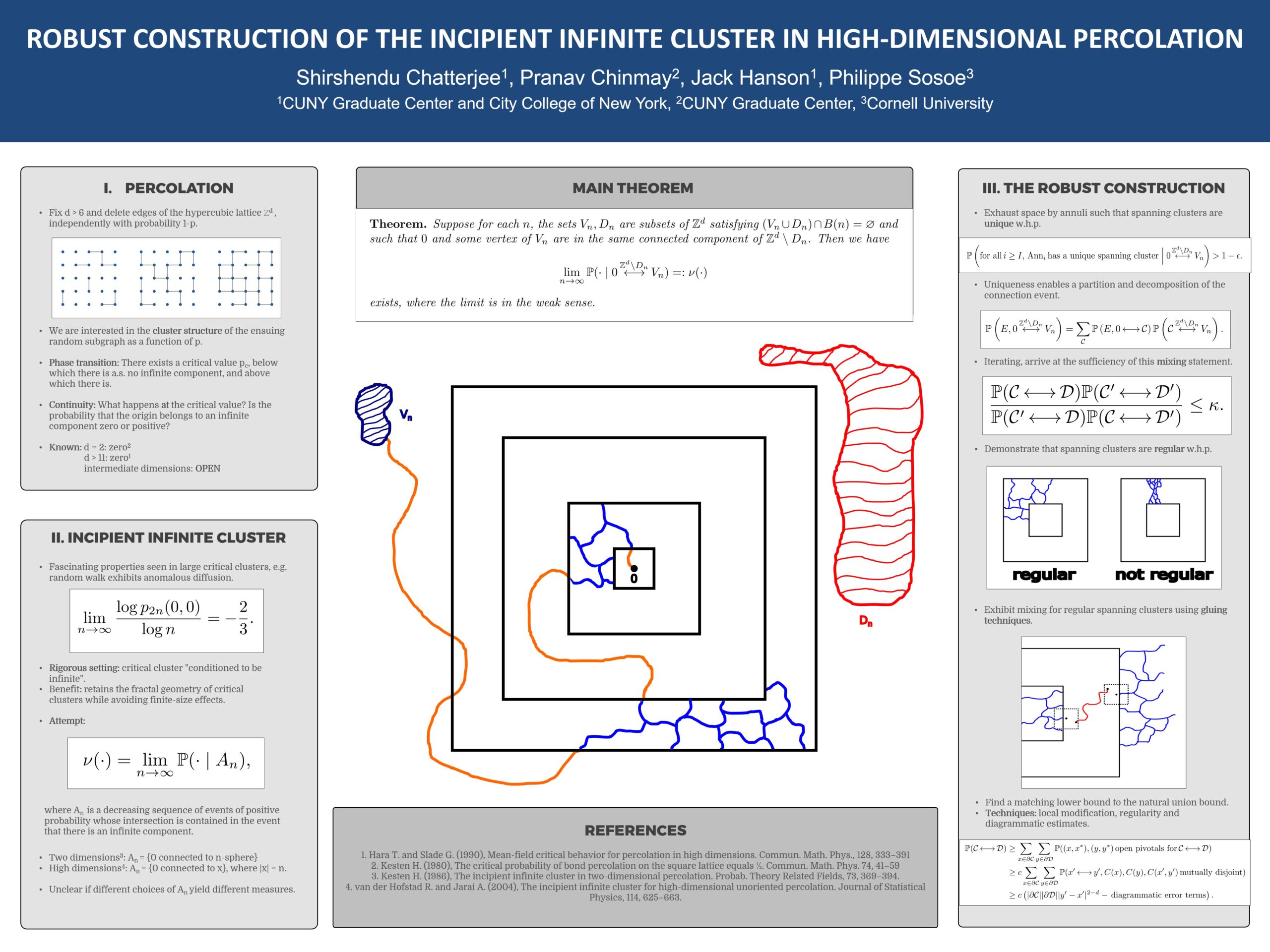
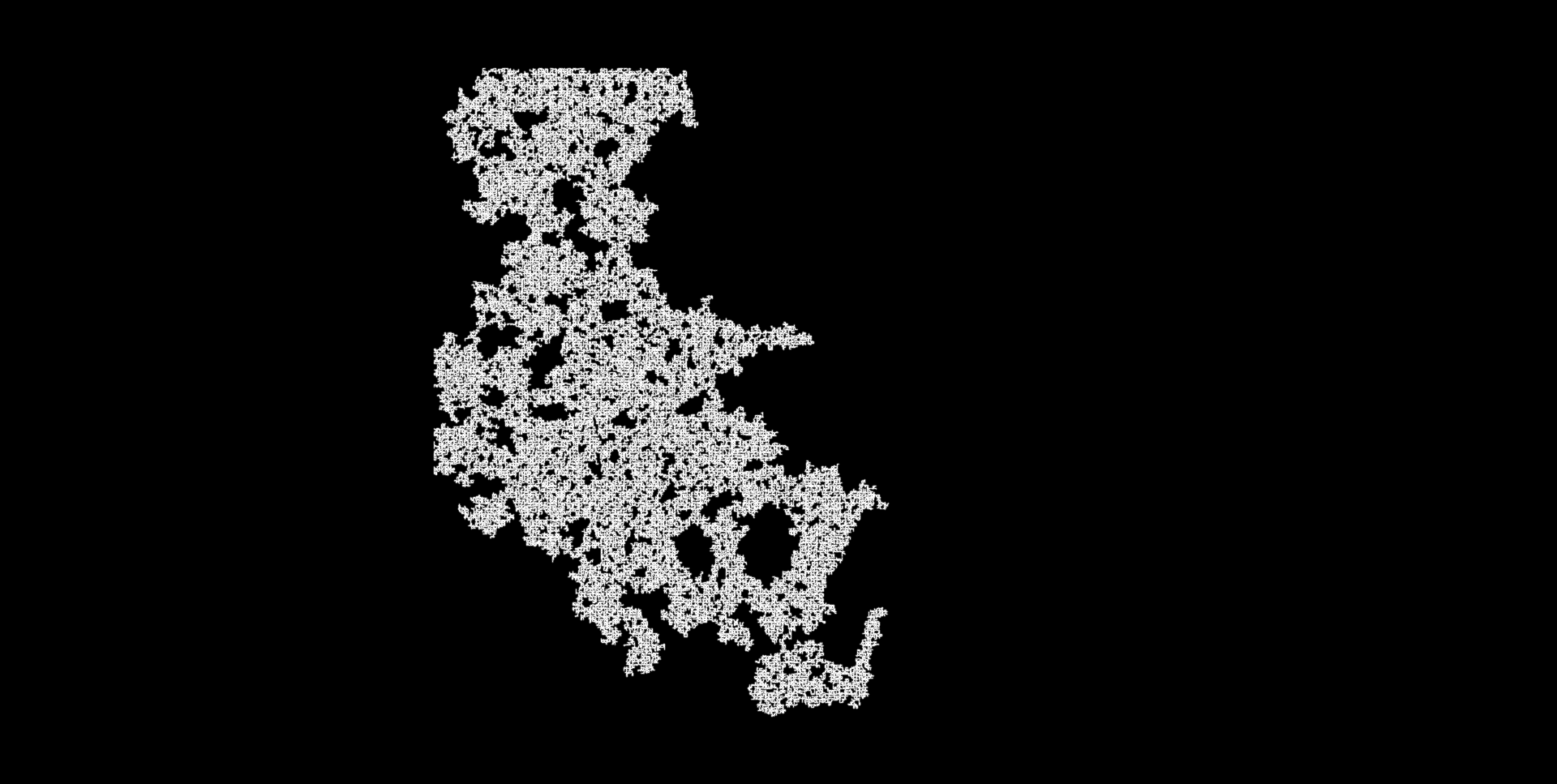
My research is in probability theory, with a current focus on high dimensional percolation. Percolation is a paradigmatic model that studies the connectivity properties of random subgraphs of various infinite transitive graphs. Many questions about its critical behavior on the high dimensional integer lattice remain open. My recent work with my collaborators has concentrated on developing new tools to answer these questions with the eventual aim of understanding the properties of the scaling limit of the incipient infinite cluster.
Robust construction of the incipient infinite cluster in high dimensional critical percolation
(joint work with Shirshendu Chatterjee, Jack Hanson, and Philippe Sosoe)
The incipient infinite cluster was first proposed by physicists in the 1970s as a canonical example of a two-dimensional medium on which random walk is subdiffusive. It is the measure obtained in critical percolation by conditioning on the existence of an infinite cluster containing the origin, which is a probability zero event in two and high dimensions. Kesten presented the first rigorous two-dimensional construction of this object as a weak limit of the one-arm event. In high dimensions, van der Hofstad and Jarai constructed the IIC as a weak limit of the two-point connection using the lace expansion. Our work presents a new high-dimensional construction which is “robust”, establishing that the same weak limit is obtained from a large class of choices of conditioning, including the one-arm and two-point connection events. We do not directly use the lace expansion—the main tools used are Kesten’s original two-dimensional construction, upper and lower bounds for the two-point function, and Kozma and Nachmias’ regularity method. This robustness proves to be a new tool that can be applied to implement geometric-style arguments in the high dimensional setting. The preprint can be found at https://arxiv.org/abs/2502.10882.
Invited talks given on this project:
- Percolation Today, online (inter-institutional, hosted by ETH Zurich). May 19th, 2025. Joint talk with Philippe Sosoe.
- GT Stochastics Seminar, Georgia Tech, Atlanta, GA. April 24th, 2025.
- Probability Seminar, Northwestern University, Evanston, IL. April 10th, 2025.
- Analysis and Probability Seminar, University of Florida, Gainesville, FL. April 4th, 2025.
- Probability Seminar, CUNY Graduate Center, New York, NY. March 25th, 2025.
Short talks given on this project:
- Northeast Probability Seminar, Columbia University, New York, NY. November 21st, 2024.
- Two-Dimensional Random Geometry, IMSI, University of Chicago, Chicago, IL. July 9th, 2024.
Limiting distribution of the chemical distance in high dimensional critical percolation
(joint work with Shirshendu Chatterjee, Jack Hanson, and Philippe Sosoe)
The chemical (intrinsic) distance is the observable that encapsulates the metric structure of percolation clusters. At criticality, heuristics suggest that the chemical distance between two connected points scales quadratically in the extrinsic distance, in line with the analogy to branching random walk. Our work presents an exact statement of this result, where the rescaled two-point chemical distance converges in distribution to a random variable whose density is expressible as a Brownian motion hitting time. The strength of the result derives from the generality of the method, which uses the robust incipient infinite cluster constructed in our previous work to enforce a novel decoupling argument that separates neighborhoods of distant pivotal vertices. In addition, this decoupling tool proves to be useful in studying the mass structure of percolation clusters, which is necessary in the steps towards a scaling limit result. The preprint can be found at https://arxiv.org/abs/2509.06236.
Invited talks given on this project:
- Penn/Temple Probability Seminar, Temple University, Philadelphia, PA. April 14th, 2026.
- Probability Seminar, Cornell University, Ithaca, NY. March 23rd, 2026.
- Probability Seminar, CUNY Graduate Center, New York, NY. Match 10th, 2026.
Short talks given on this project:
- Northeast Probability Seminar, CUNY Graduate Center, New York, NY. November 20th, 2025.